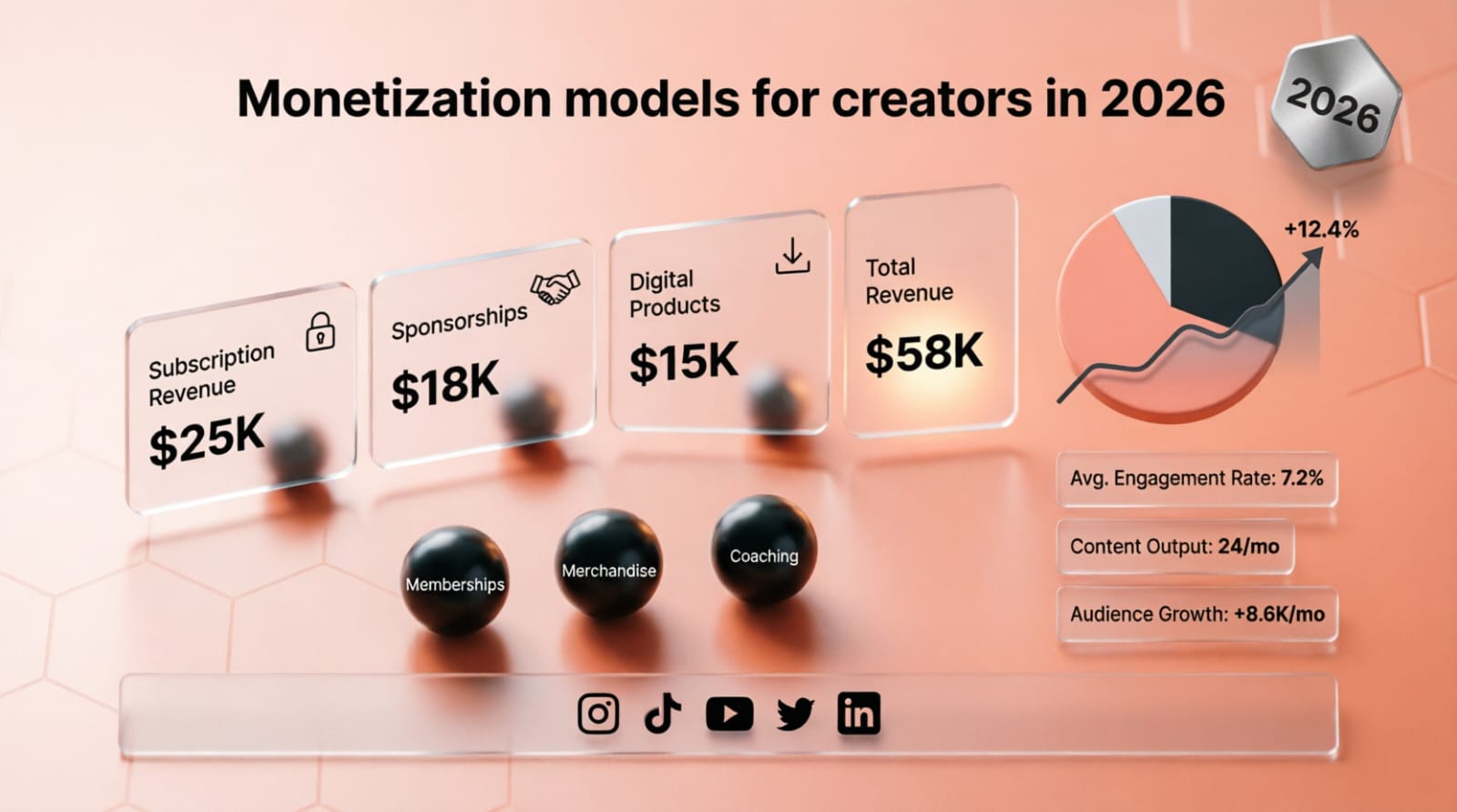
The Monetization Shift in 2026: From Single Streams to Revenue Architecture
The creator economy has moved past the era of picking one income model and hoping it sticks. In 2026, monetization is no longer a tactical choice—it's a structural discipline. The question isn't "how do I make money?" It's "how do I architect a revenue portfolio that aligns with my audience, my content format, and my operational capacity?"
Platform-native payouts have plateaued. Ad revenue sharing is volatile. Sponsorship cycles are shortening. Meanwhile, creator tooling, privacy-first tracking, and direct-to-consumer commerce have matured. The creators scaling sustainably aren't chasing trends; they're engineering layered income systems that compound over time.
This guide strips away the noise. We'll break down the four core monetization models, map their operational realities, and provide a decision framework to help you choose, sequence, and scale the right streams for your business. If you're ready to move from guessing to architecting, this is your blueprint.
The Creator Revenue Matrix: Evaluating Models by Reality, Not Hype
Not all monetization paths are created equal. Each model carries distinct trade-offs across five critical dimensions: barrier to entry, profit margin, scalability, audience dependency, and time-to-first-dollar. Understanding these variables prevents misaligned bets and accelerates strategic sequencing.
| Model | Barrier to Entry | Profit Margin | Scalability | Audience Dependency | Time-to-First-Dollar |
|---|---|---|---|---|---|
| Affiliate Marketing | Low | Medium (10-50%) | High (intent-driven) | Medium (requires trust, not size) | Days to weeks |
| Digital Products | Medium | Very High (70-95%) | Very High (zero marginal cost) | High (requires validated demand) | Weeks to months |
| Subscriptions/Memberships | Medium-High | High (recurring, predictable) | Medium (churn management required) | Very High (requires deep loyalty) | Months |
| Brand Partnerships | High | Variable (flat fee or hybrid) | Low-Medium (campaign-based) | Very High (audience size & engagement) | Months |
The matrix reveals a critical truth: no single model dominates across all dimensions. Affiliate marketing wins on speed and scalability. Digital products win on margin and control. Subscriptions win on cash flow stability. Brand deals win on premium positioning and upfront capital. The 2026 advantage belongs to creators who treat these as complementary layers, not competing options.
Deep Dive: The Four Core Models (Operational Realities in 2026)
1. Affiliate Marketing: The Foundational Layer
Affiliate marketing remains the most accessible, intent-aligned monetization model for creators at any stage. It requires no product development, no customer support infrastructure, and no upfront capital. Instead, it leverages your existing content to bridge audience problems with validated solutions.
2026 Shifts: The model has evolved from link-dropping to conversion architecture. Privacy-first tracking, curated marketplaces, and real-time attribution dashboards have replaced spreadsheet guessing. Platforms like Voxlinker now provide pre-vetted product libraries, transparent commission structures, and performance analytics that allow creators to optimize RPV (Revenue Per Visitor) instead of chasing raw clicks.
Ideal For: Creators with consistent traffic, niche expertise, and content that naturally aligns with commercial intent (reviews, comparisons, tutorials, workflow breakdowns).
Operational Checklist:
- ✅ Map content to buyer journey stages (awareness → consideration → decision)
- ✅ Use contextual CTAs, not footer link dumps
- ✅ Track CTR, CVR, and RPV weekly; iterate based on data
- ✅ Prioritize 30-90 day cookie windows and reliable payout histories
For a complete framework on building high-converting affiliate funnels, explore The Ultimate Affiliate Funnel for High-Converting Traffic in 2025.
2. Digital Products: The Margin Engine
Digital products transform audience trust into high-margin revenue. Unlike affiliate marketing, you own the product, the pricing, the customer relationship, and the profit margin. In 2026, the market has shifted from "info-dump courses" to outcome-based, productized solutions that deliver measurable results.
High-Performing Formats:
- Templates & Toolkits: Notion systems, swipe files, pricing calculators, workflow automations.
- Micro-Courses & Cohorts: Focused, 2-4 hour programs with community accountability and implementation support.
- Productized Services: Fixed-scope audits, strategy sessions, or done-for-you setups with clear deliverables.
2026 Reality: Buyers are fatigued by theoretical content. They purchase outcomes, not information. Successful digital products include implementation frameworks, real-case examples, and post-purchase support that reduces refund rates and increases lifetime value.
Ideal For: Creators with validated audience demand, documented expertise, and the capacity to build, launch, and iterate on product-market fit.
Operational Checklist:
- ✅ Validate demand before building (pre-sales, waitlists, survey data)
- ✅ Price based on outcome value, not hour count
- ✅ Build a simple sales page with clear deliverables, social proof, and refund policy
- ✅ Use email sequences to nurture leads and reduce cart abandonment
3. Subscriptions & Memberships: The Stability Layer
Recurring revenue transforms volatile creator income into predictable cash flow. Subscriptions work best when they solve an ongoing problem, provide continuous value, and foster community belonging. In 2026, the model has matured beyond "exclusive content paywalls" into structured membership ecosystems.
Tiered Architecture That Works:
- Entry Tier ($5-15/mo): Community access, monthly templates, live Q&As, curated resource library.
- Core Tier ($25-50/mo): In-depth training, implementation workshops, peer accountability groups, direct feedback channels.
- Premium Tier ($100+/mo): 1:1 strategy sessions, done-for-you assets, early access to products, private mastermind.
2026 Reality: Churn is the silent killer. Memberships fail when value delivery becomes inconsistent or when community engagement drops. Successful creators treat subscriptions as a product, not a perk. They schedule content drops, facilitate discussions, track retention metrics, and continuously iterate based on member feedback.
Ideal For: Creators with deep audience trust, consistent engagement, and the operational discipline to deliver recurring value without burnout.
Operational Checklist:
- ✅ Launch only after validating demand through free community or email list
- ✅ Set clear expectations: what members get, how often, and how to engage
- ✅ Track churn rate, active participation, and lifetime value monthly
- ✅ Use onboarding sequences to reduce early cancellation
4. Brand Partnerships & Sponsorships: The Amplification Layer
Brand deals provide high-ticket, upfront capital and premium positioning. However, they are inherently campaign-based, relationship-dependent, and vulnerable to market shifts. In 2026, the sponsorship landscape has pivoted from one-off posts to long-term ambassador roles and performance-based hybrid deals.
Modern Partnership Structures:
- Flat Fee + CPA: Guaranteed base payment plus commission on tracked sales.
- Revenue Share: Percentage of sales driven through unique codes or links.
- Long-Term Ambassador: 6-12 month contracts with consistent deliverables and deeper brand integration.
2026 Reality: Brands no longer pay for follower counts. They pay for engagement quality, audience alignment, and conversion track records. Micro-creators with 10K highly engaged followers often command higher rates than macro-creators with 500K passive scrollers. Transparency, content quality, and audience trust are the new currency.
Ideal For: Creators with established audience trust, consistent engagement metrics, professional media kits, and the capacity to negotiate, deliver, and report on campaign performance.
Operational Checklist:
- ✅ Build a media kit with audience demographics, engagement rates, and past performance
- ✅ Pitch brands that align with your niche and audience intent
- ✅ Negotiate usage rights, exclusivity windows, and payment terms upfront
- ✅ Track campaign ROI and share performance reports to secure renewals
The Revenue Stacking Framework: Sequencing for Scale
Combining income streams isn't about doing everything at once. It's about strategic sequencing. The most resilient creator businesses follow a phased stacking model that validates demand, captures margin, stabilizes cash flow, and amplifies positioning—without fracturing focus.
| Phase | Primary Model | Objective | Success Signal to Advance |
|---|---|---|---|
| Phase 1: Validation | Affiliate Marketing | Test demand, build trust, generate initial cash flow | Consistent CTR/CVR, 3+ months of predictable affiliate revenue |
| Phase 2: Margin Capture | Digital Products | Own the product, increase profit margin, deepen authority | Validated audience pain points, email list growth, pre-sale interest |
| Phase 3: Stability | Subscriptions/Memberships | Recurring revenue, community moat, reduced volatility | High engagement, consistent content delivery, low churn tolerance |
| Phase 4: Amplification | Brand Partnerships | Premium positioning, upfront capital, cross-audience reach | Established media kit, proven conversion track record, negotiation capacity |
This sequencing minimizes risk, maximizes learning, and prevents premature scaling. You don't need a massive audience to start. You need alignment, iteration, and systematic execution. For a complete roadmap on transitioning from sporadic income to scalable revenue architecture, explore How Creators Scale Affiliate Revenue in 2025.
Decision Diagnostic: Choosing Your Starting Point
Monetization isn't one-size-fits-all. Your optimal starting model depends on five structural variables. Use this diagnostic to map your path:
- Audience Size & Engagement: Under 5K? Start with affiliate marketing or micro-digital products. Over 10K with high engagement? Explore subscriptions or brand outreach.
- Content Format: Video-heavy? Affiliate links and sponsorships align naturally. Text/long-form? SEO-driven affiliate hubs and digital product sales pages perform best. Community-focused? Memberships and peer-driven offers scale fastest.
- Niche Economics: High-ticket niches (finance, SaaS, B2B) favor affiliate and consulting. Volume-driven niches (lifestyle, entertainment) favor digital products and sponsorships. Service-based niches (coaching, design) favor productized services and subscriptions.
- Operational Capacity: Solo creator? Prioritize low-overhead models (affiliate, templates). Small team? Expand into courses, memberships, and campaign management. Burnout-prone? Avoid high-delivery models until systems are documented.
- Risk Tolerance: Low risk? Affiliate marketing and digital products require minimal upfront investment. Higher risk/reward? Subscriptions and brand deals require deeper audience commitment and negotiation capacity.
Match your variables to the model that aligns with your current capacity. You can always layer additional streams later. The goal is momentum, not perfection.
Optimization Levers & Structural Pitfalls
Even the right model fails without operational discipline. Here are the four most common monetization bottlenecks and how to dismantle them:
- Premature Scaling: Launching a course or membership before validating demand leads to high refunds and churn. Fix: Run pre-sales, waitlists, or pilot cohorts before full launch.
- Misaligned Offers: Pushing high-ticket products to low-intent traffic, or affiliate links to audiences seeking free education. Fix: Map offers to buyer journey stages. Use intent-aligned content architecture.
- Neglecting Retention: Treating monetization as a one-time transaction instead of a relationship. Fix: Implement post-purchase onboarding, nurture sequences, and community touchpoints to increase LTV.
- Data Blindness: Tracking revenue but ignoring CAC, churn, RPV, or conversion drop-off points. Fix: Set up integrated analytics. Review unit economics monthly. Optimize based on margins, not just top-line revenue.
For advanced conversion frameworks and RPV optimization tactics, dive into Conversion Mastery 2026: Turn More Clicks Into Commissions and Maximize Revenue Per Visitor: The 2026 Playbook.
The 2026 Monetization Playbook: Your Execution Checklist
To build a sustainable, scalable revenue architecture in 2026, implement this operational framework:
- ✅ Start with one model that aligns with your audience, content, and capacity.
- ✅ Validate demand before building products or launching subscriptions.
- ✅ Track unit economics: CAC, LTV, margin, churn, and RPV.
- ✅ Sequence strategically: affiliate → digital → subscription → brand.
- ✅ Automate delivery, nurture sequences, and retention touchpoints.
- ✅ Iterate based on data, not assumptions. Retire underperformers quickly.
- ✅ Treat monetization as a portfolio, not a lottery ticket.
Monetization in 2026 isn't about complexity. It's about alignment. The creators who win aren't the ones chasing every trend—they're the ones who build layered, data-driven systems that compound over time. Start simple. Validate relentlessly. Scale systematically. The infrastructure exists. The only variable left is execution.
Frequently Asked Questions
Do I need a large audience to start monetizing?
No. Affiliate marketing and digital products can generate revenue with fewer than 1,000 engaged followers. Intent alignment and trust matter far more than raw follower count. Focus on audience quality, not quantity.
Which monetization model is the most profitable?
Digital products offer the highest margins (70-95%), but require product-market fit and audience trust. Affiliate marketing offers the fastest path to first dollar with lower margins. Subscriptions provide predictable cash flow but require retention discipline. Profitability depends on alignment, not model alone.
How do I know when to add a second income stream?
Add a second stream only after your primary model hits consistent performance baselines (e.g., 3+ months of predictable revenue, documented workflows, and clear unit economics). Premature layering fractures focus and stalls growth.
Can I monetize without showing my face or being on camera?
Absolutely. SEO-driven blogs, template shops, newsletter subscriptions, and affiliate review hubs consistently generate revenue without camera presence. Authenticity and value delivery matter more than format.
How do I price digital products or subscriptions?
Price based on outcome value, not hour count. Research competitor pricing, validate willingness-to-pay through surveys or pre-sales, and start with a mid-tier price point. Offer payment plans for high-ticket products, and use tiered membership structures to capture different budget levels.
What's the biggest monetization mistake creators make in 2026?
Chasing volume over alignment. Launching products to cold traffic, pushing affiliate links without trust, or scaling subscriptions before building retention systems. Monetization fails when it's treated as a transaction instead of a relationship. Map offers to intent, track unit economics, and iterate based on data.