Why most affiliate traffic fails
Many creators believe that affiliate marketing is simply about sending traffic to a link. Post a review, drop a URL, wait for commissions. In reality, this is the biggest mistake holding back 90% of affiliate marketers. Raw traffic without a structured funnel leads to low conversions, wasted clicks, and missed revenue opportunities that compound over time.
Consider this: the average affiliate link click-through rate hovers around 2-3%, and conversion rates typically range from 1-5%. But top-performing creators? They're seeing 8-12% conversion rates by implementing structured funnels. The difference isn't luck—it's architecture.
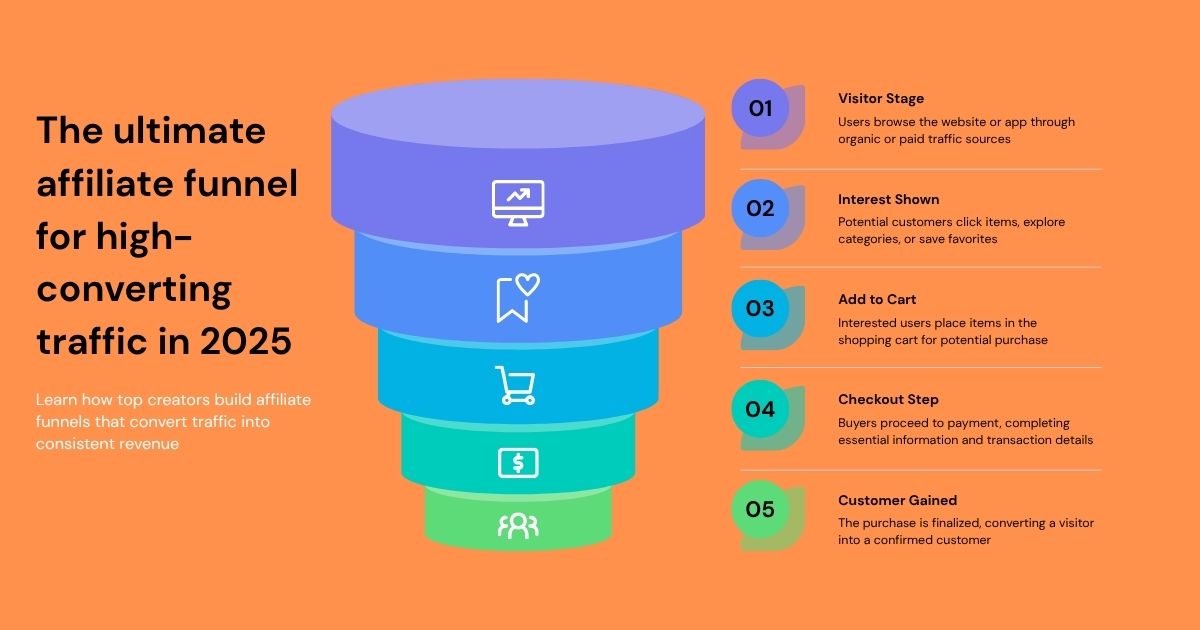
In 2025, successful affiliate marketers no longer rely on direct linking or hoping for viral moments. Instead, they build optimized, psychology-driven funnels that guide users step by step toward a purchase decision. This isn't about manipulation; it's about removing friction and aligning your content with how people actually make buying decisions.
If you're tired of watching traffic come and go without meaningful revenue, this guide is your blueprint. We'll break down the exact five-step funnel framework that top affiliates use to turn casual visitors into loyal buyers—and how platforms like Voxlinker make implementation seamless.
What is an affiliate funnel?
An affiliate funnel is a structured journey that transforms a visitor into a buyer. Instead of sending users directly to a product page (where most bounce immediately), you first capture attention, build trust, provide value, and then introduce the offer in a strategic, contextually relevant way.
Think of it as a conversation, not a transaction. A well-designed funnel respects the user's decision-making process and meets them where they are. The most effective affiliate funnels follow this psychological progression:
- Awareness: Attract the right audience with content that solves a problem or sparks curiosity.
- Interest: Provide valuable, educational content that positions you as a trusted resource.
- Trust: Build credibility through transparency, social proof, and authentic recommendations.
- Conversion: Present the offer as the natural next step, with clear CTAs and minimal friction.
This framework isn't theoretical. Creators who implement structured funnels report 3-5x higher revenue per visitor compared to those using direct-link strategies. For a deeper dive into conversion psychology, explore our guide on Affiliate Click Psychology: What Makes Users Actually Click.
Step 1: Attracting high-quality traffic
Not all traffic is equal—and treating it as such is the fastest way to waste time and energy. A thousand visitors from a viral TikTok might sound impressive, but if none of them are interested in your niche, your conversion rate will be near zero. Meanwhile, 100 visitors from a targeted SEO blog post about "best budget running shoes for beginners" could generate multiple sales.
The key to a successful funnel starts with intent-based targeting. You're not just looking for eyeballs; you're looking for people who are already thinking about the problem your affiliate product solves.
- Focus on niche-specific audiences: Instead of "fitness," target "postpartum fitness for busy moms." Specificity attracts higher-intent users.
- Use problem-solving content: Create content that answers real questions: "How to fix X," "Best tools for Y," "Why Z isn't working."
- Avoid spammy promotion techniques: Clickbait headlines and misleading thumbnails might drive clicks, but they destroy trust and kill long-term conversions.
High-quality traffic means users already interested in your niche, making them more likely to convert. This is why SEO-driven blogs, targeted Pinterest pins, and niche community engagement often outperform broad-reach viral content for affiliate revenue. For more on attracting the right audience, see our guide on Traffic Domination 2026: How to Attract High-Intent Visitors.
Pro Tip: Use Voxlinker's analytics dashboard to track which traffic sources drive the highest click-through and conversion rates. Double down on what works, and stop wasting energy on channels that don't convert.
Step 2: Capture attention with value
Before asking users to click your affiliate link, you need to earn their attention—and the only currency that works in 2025 is genuine value. Users are skeptical of promotions, but they're hungry for solutions. Your job is to bridge that gap.
Content that educates and solves problems naturally leads users to trust your recommendations. This isn't about hiding your affiliate relationship; it's about leading with help, not hype.
- Write detailed product reviews: Don't just list features. Share your experience, include pros/cons, and explain who the product is (and isn't) for.
- Create comparison guides: "Product A vs Product B" content performs exceptionally well because it helps users make faster decisions.
- Share real experiences: Case studies, before/after results, and personal stories build authenticity that stock photos can't replicate.
The most effective content doesn't feel like marketing. It feels like a helpful friend sharing a discovery. When you lead with value, the affiliate link becomes a natural extension of the conversation, not an interruption.
Example: A creator promoting a project management tool might write "How I Cut My Weekly Planning Time by 60%" instead of "Best Project Management Tool 2025." The first attracts users with a problem; the second attracts users who are already shopping. Both work, but the first builds more trust and often converts better.
For inspiration on high-value content formats, check out our case study on How One Piece of Content Generated Recurring Affiliate Income.
Step 3: Build trust before selling
Trust is the most important factor in affiliate marketing. Users will not buy from someone they don't trust—no matter how compelling the offer. The best creators focus on long-term credibility rather than short-term profit, understanding that one trusted recommendation can generate more revenue than a dozen aggressive promotions.
Building trust isn't about being perfect; it's about being transparent, consistent, and human.
- Be transparent about affiliate links: A simple "This post contains affiliate links" disclaimer actually increases trust. Users appreciate honesty, and it's legally required in most regions.
- Share honest pros and cons: No product is perfect. Acknowledging limitations makes your recommendations more credible, not less.
- Avoid overpromising results: "This tool changed my life!" might sound exciting, but "This tool helped me save 3 hours/week" is more believable and sustainable.
When trust is established, conversions increase naturally. Research shows that trusted recommendations convert 3-5x higher than generic promotional content. This is why creators who consistently provide value, even when not promoting, see higher affiliate earnings over time.
Trust-Building Checklist: - Do I actually use this product? - Would I recommend it to a friend who isn't paying me? - Am I being clear about what the product can and can't do? - Does this recommendation align with my audience's needs?
For more on building authority in your niche, explore our guide on Creator Growth Strategy: Building Authority That Converts.
Step 4: Optimize your conversion path
Your funnel should make it easy for users to take action. This means clear calls to action, simple navigation, and optimized landing pages. Every extra click, confusing instruction, or slow load time reduces your conversion rate.
In affiliate marketing, friction is the enemy. The goal isn't to trick users into clicking—it's to remove every barrier between their interest and their action.
- Use clear and compelling CTAs: Instead of "Click here," try "Get the exact tool I use here" or "Start your free trial with my link." Specificity drives action.
- Reduce friction in the user journey: Place affiliate links where they're contextually relevant. A link in the middle of a helpful tutorial converts better than one buried in a generic footer.
- Test different layouts and strategies: A/B test your headlines, button colors, link placements, and CTA phrasing. Small improvements compound into significant revenue gains.
Even small improvements in your funnel can significantly increase your earnings. A 0.5% increase in click-through rate or a 1% bump in conversion rate might seem minor, but across thousands of visitors, it translates to hundreds or thousands of dollars in additional monthly revenue.
Pro Tip: Use Voxlinker's real-time analytics to track which links, placements, and CTAs drive the highest conversions. Data-driven optimization isn't optional in 2025—it's the baseline for scaling.
For a deeper dive on maximizing every visitor, see our guide on Maximize Revenue Per Visitor: The 2026 Playbook.
Step 5: Analyze and scale
The most successful affiliate marketers don't just set funnels and forget them. They constantly analyze their data, identify what works, and scale winning strategies. This is the difference between hobbyists and professionals.
Scaling isn't about doing more—it's about doing more of what works. Instead of creating 10 new pieces of content, double down on the 2 that are already converting.
- Monitor click-through rates: Which headlines, thumbnails, or CTAs get the most clicks? Replicate those patterns.
- Track conversions and revenue: Not all clicks are equal. Focus on the content that drives actual purchases, not just traffic.
- Double down on high-performing content: If a blog post or video is converting well, create variations, update it with fresh information, or repurpose it for other platforms.
This iterative approach ensures continuous improvement. Top creators treat their affiliate business like a science: hypothesize, test, measure, optimize, repeat.
Scaling Framework: 1. Identify your top 20% of content (by revenue, not views) 2. Analyze what makes it work (topic, format, CTA, placement) 3. Create 3-5 variations of that winning formula 4. Test and measure results 5. Repeat with the new winners
For a complete system on scaling affiliate income, explore our guide on How Creators Scale Affiliate Revenue in 2025.
The future of affiliate funnels
Affiliate marketing is becoming more sophisticated. Creators who build structured, data-driven funnels will outperform those who rely on random traffic and direct links. The gap isn't narrowing—it's widening.
In the coming years, three trends will shape high-converting affiliate funnels:
- AI-Assisted Optimization: Tools that analyze performance data and suggest content improvements will become standard. AI won't replace creators—it will amplify them.
- Privacy-First Tracking: With third-party cookies disappearing, first-party data and platform-native tracking will dominate. Solutions like Voxlinker's smart attribution will become essential.
- Integrated Ecosystems: Platforms that combine link management, analytics, payouts, and product discovery in one place will save creators time and reduce friction.
If you want to succeed in affiliate marketing in 2025, building a strong funnel is no longer optional—it is essential. But you don't have to build it from scratch. Platforms like Voxlinker provide the tools to create, track, and optimize high-converting funnels without the technical complexity.
Your audience is waiting. Your income is waiting. The only variable left is execution.
Frequently Asked Questions
What is the average conversion rate for affiliate funnels in 2025?
The average affiliate conversion rate ranges from 1-5%, but top-performing funnels with intent-based traffic and trust-driven content consistently achieve 8-12%. The key is optimizing each stage of the funnel, not just the final click.
How long does it take to see results from a new affiliate funnel?
Most creators see initial clicks within the first 2-4 weeks, but meaningful revenue typically builds over 3-6 months as content compounds, SEO ranks, and audience trust grows. Consistency and data optimization accelerate the timeline.
Do I need a large audience to build a profitable affiliate funnel?
No. Micro-creators with 1,000-10,000 highly engaged followers often outperform accounts with 100K+ passive viewers. Intent, trust, and niche relevance drive conversions far more than raw follower count. Focus on audience quality, not quantity.
What's the biggest mistake creators make when building funnels?
Skipping the trust-building stage. Many creators jump straight from awareness to conversion, asking users to buy before establishing credibility. This leads to low conversion rates and high bounce rates. Always provide value first.
How can I track my funnel performance effectively?
Use a dedicated affiliate dashboard like Voxlinker's analytics suite to monitor CTR, CVR, and revenue per visitor in real time. Avoid manual spreadsheets—they don't scale and lead to missed optimization opportunities.