The Myth of Massive Traffic: Why 5,000 Visitors Can Outperform 50,000
Let’s address the elephant in the room immediately. In the creator economy, there is a pervasive, toxic myth that you need 100,000 monthly visitors to make a living. This belief keeps thousands of talented creators stuck in the "hobbyist" phase, paralyzed by vanity metrics, waiting for a traffic threshold that may never come.
The reality is mathematical, not magical: Traffic volume is irrelevant without intent.
Consider this scenario: Creator A drives 50,000 visitors to a "funny cat memes" blog and monetizes with low-RPM display ads. Their monthly revenue? Maybe $400. Creator B drives 4,800 visitors to a niche productivity blog, targeting users actively searching for software solutions. Their monthly revenue? $1,000+.
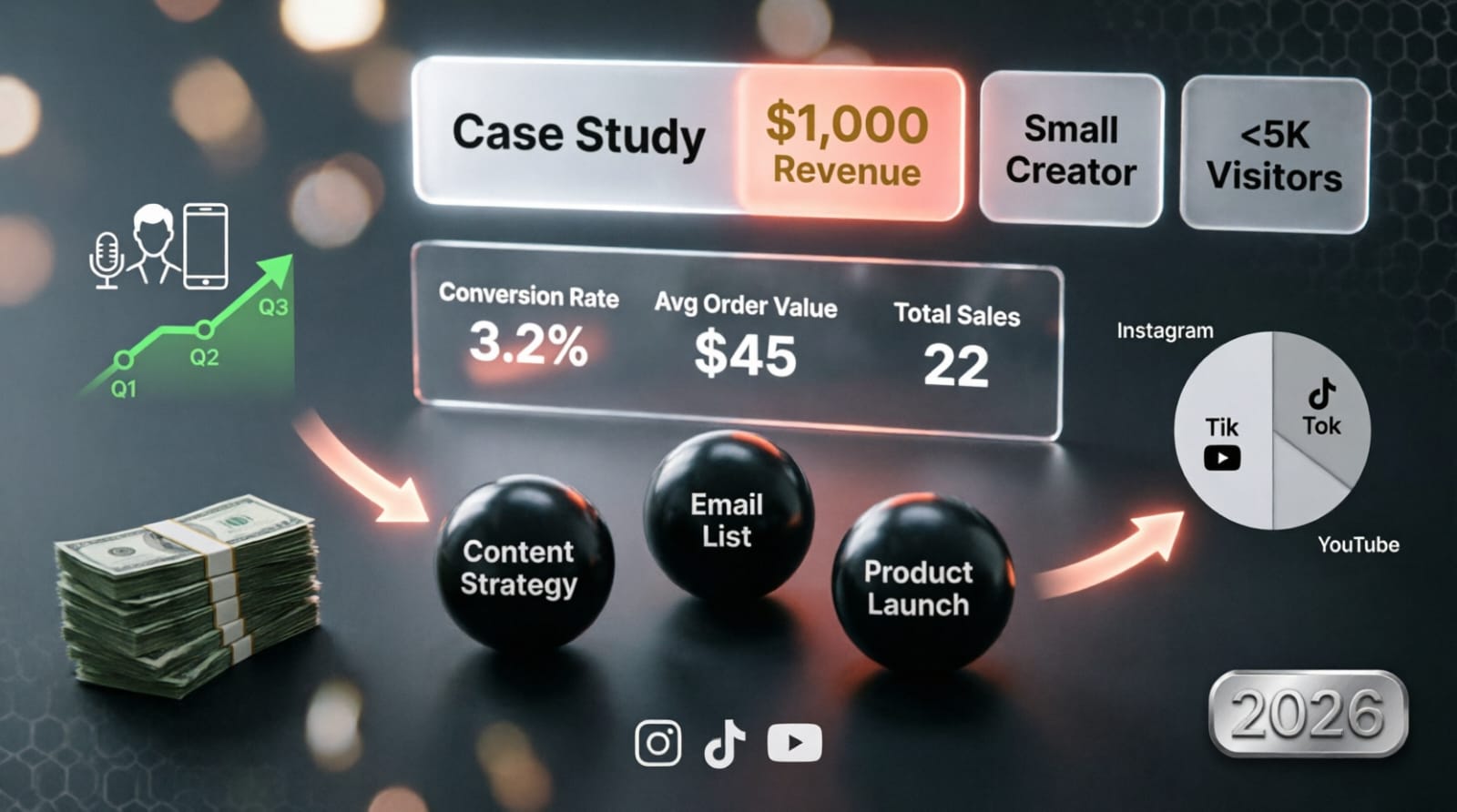
This case study isn’t about luck. It’s about the strategic deployment of Revenue Per Visitor (RPV). It demonstrates how a small, niche-focused project—with zero paid ads and a massive social following—can generate consistent four-figure income by optimizing for efficiency over scale.
The Setup: Constraints Breeding Creativity
Before dissecting the strategy, we need to understand the environment. This was not a media empire. It was a solo operator running a lean operation with significant constraints:
- Niche: Productivity Tools & SaaS (High ticket, recurring commissions).
- Traffic Volume: ~4,800 monthly visitors.
- Traffic Source: 80% SEO (Long-tail keywords), 20% Niche Communities.
- Content Volume: Only 14 published articles.
- Monetization: Pure affiliate marketing (No own products, no ads).
Most creators look at these numbers and see limitations. This creator saw them as parameters. Without the cushion of massive traffic, there was no room for error. Every word, every headline, and every link had to earn its keep. This forced a shift from "broadcasting" to "sniper positioning."
The Strategic Pivot: Intent Over Impressions
The core philosophy of this case study is simple: Don't chase the crowd; chase the buyer.
Large websites often optimize for "Top of Funnel" awareness—broad topics like "What is Time Management?" These articles get thousands of views but almost zero clicks, because the reader is in learning mode, not buying mode.
This creator ignored the crowd. Instead, they focused exclusively on Commercial Intent. They targeted users who were holding their credit cards and looking for validation.
The "Sniper" Keyword Strategy
The content focused on queries that signaled purchase readiness. Instead of writing "Best Productivity Apps," they wrote:
- "Notion vs. Asana for Remote Teams: Which Saves More Time?"
- "Best Expense Tracking Software for Freelancers (2026 Review)."
- "Is [Tool Name] Worth It? A 30-Day Test."
These searches have lower volume but drastically higher conversion rates. When someone searches for a comparison or a review, they are at the bottom of the funnel. They don't need education; they need a decision. By intercepting these users, the creator ensured that nearly every visitor was a potential buyer.
For a deeper breakdown of how to attract this specific type of high-value traffic, explore our guide on Traffic Domination 2026: How to Attract High-Intent Visitors.
Depth as a Moat: Why 14 Articles Beat 140
In an era of AI-generated content flooding the web, "good enough" is no longer enough. Google and users alike reward depth, experience, and nuance.
This creator published fewer than 15 articles in their first six months. But each article was a Pillar Asset. These weren't 500-word listicles; they were 3,000-word comprehensive guides featuring:
- Real Testing Data: Screenshots of the actual dashboard, pros/cons based on usage.
- Workflow Integration: "Here is exactly how I use this tool to save 5 hours a week."
- Objection Handling: Addressing pricing concerns, learning curves, and limitations honestly.
This approach created a "Trust Moat." When a user lands on a page that clearly demonstrates expertise, they don't shop around. They convert. Search engines recognized this depth, ranking these articles above larger competitors who had thinner, less helpful content.
In this model, one high-quality asset can generate recurring revenue for years. It’s not about volume; it’s about asset value. For a real-world example of how a single piece of deep content can drive income, read our case study: how one piece of content generated recurring affiliate income.
The Invisible Salesman: Contextual Monetization
Traffic without conversion is just noise. The secret sauce of this $1,000 result wasn't the traffic itself; it was the monetization architecture.
Most beginners slap affiliate links in the sidebar or dump them at the end of the post. This creator used a Contextual Integration Framework:
- The Problem Agitation: The article starts by validating the user's pain (e.g., "Tired of losing receipts?").
- The Solution Demonstration: The tool is introduced as the hero that solves the pain.
- The Contextual CTA: The affiliate link is placed inside the workflow explanation, not as an ad. "Click here to start your free trial" becomes "Click here to automate your receipts."
This reduces "banner blindness." The link feels like a helpful resource, not a sales pitch. The click-through rate (CTR) on these contextual links was consistently above 6%, compared to the industry average of 2%.
Understanding the psychology behind why users click is crucial. For the behavioral triggers that drive ethical conversions, read Why People Actually Click Affiliate Links in 2026 (Psychology of Conversions).
The Results: The Math of Efficiency
Let’s look at the final numbers to see the efficiency in action:
| Metric | The Result | Why It Matters |
|---|---|---|
| Monthly Visitors | 4,800 | Low volume, but 100% niche-targeted. |
| Avg. Commission | $25 - $40 (SaaS) | High ticket items require fewer sales to hit goals. |
| Conversion Rate | ~3.5% | 3x industry average due to high intent. |
| Monthly Revenue | $1,000+ | Consistent, predictable income. |
The takeaway is clear: You don't need a stadium; you need a room full of buyers. By focusing on RPV (Revenue Per Visitor) rather than raw traffic, the creator built a sustainable asset that works 24/7.
The Blueprint: How to Replicate This
This isn't a unique talent; it's a replicable system. If you want to achieve similar results, follow this execution path:
- Step 1: Niche Down. Choose a niche with high commercial value (Finance, SaaS, Health, Tech).
- Step 2: Keyword Sniper. Use tools to find "Best X for Y" and "X vs Y" keywords. Ignore broad terms.
- Step 3: Create Pillars. Write fewer, deeper articles. Focus on experience and data.
- Step 4: Contextualize Links. Embed recommendations naturally within the solution.
- Step 5: Optimize RPV. Track which articles convert best and double down on those topics.
For a complete guide on scaling this type of revenue architecture, see How Creators Scale Affiliate Revenue in 2025.
Final Insight: Small is the New Big
This case study challenges the vanity of the creator economy. It proves that scale is not a prerequisite for success; it is often a byproduct of it.
You do not need millions of views to change your financial reality. You need the right audience, the right offer, and the right system. When you stop chasing everyone and start serving the right someone, the math takes care of itself.
Focus on intent. Build assets. Trust the compounding effect.
Frequently Asked Questions
How long did it take to reach these results?
It took approximately 4 months to gain traction. SEO is a compounding game. The first 60 days saw minimal traffic, but as domain authority grew and the 14 articles ranked, traffic and revenue accelerated rapidly in months 3 and 4.
Do I need a website to do this?
A website (blog) is the most effective vehicle for this strategy because it allows for deep SEO content and contextual link placement. While social media can work, it is harder to build the "Depth Moat" and capture high-intent search traffic on social platforms.
Why did SaaS/Productivity tools work best?
SaaS (Software as a Service) products often offer recurring commissions (you get paid every month the user stays subscribed). Additionally, the "pain" of disorganization is high, making users more willing to pay for solutions. This combination of high ticket value and recurring revenue makes it ideal for small traffic volumes.
Can I apply this to a different niche?
Absolutely. The framework applies to any niche where users have a problem and are willing to pay for a solution. Finance, health supplements, and outdoor gear are other high-performing examples. The key is to focus on Commercial Intent keywords regardless of the industry.